Episode Transcript
[00:00:00] Speaker A: In the early 1900s, there were as many as 20,000 different kinds of apples grown across the country. Today, experts say two thirds of those varieties have gone extinct. Efforts to find and regrow the rarest apples have sprouted up in different parts of the US from southwest Colorado, Adam Burke brings us this story of the search for one rare apple.
[00:00:25] Speaker B: See, that's already dead.
[00:00:27] Speaker C: In an orchard south of Mancus, Colorado, Jude and Addie Schuenemeyer are taking cuttings from an apple tree that is barely alive.
[00:00:36] Speaker B: The tree doesn't have a lot of time left on it.
[00:00:39] Speaker C: They snip off little pieces of new growth, each the size of a birthday candle. And later they'll graft these pieces onto rootstock.
[00:00:48] Speaker D: This is what we use to make new baby trees.
[00:00:51] Speaker C: They don't know what kind of tree this one is, but they do know from genetic testing it's extremely rare.
[00:00:59] Speaker D: It's a lost apple.
[00:01:00] Speaker B: It's one of the rarest apples on earth.
[00:01:02] Speaker D: And even if we never know its historic name again, it's still worthy of preserving.
[00:01:11] Speaker B: Doing apple detective work, it is difficult. You're having to combine remarkable high tech, cutting edge DNA with deep historical research.
And it's easy to guess wrong with apples. It's easy to look at an apple and say, oh, it must be this or it must be that. In finding out, you're wrong.
[00:01:32] Speaker C: The Schnemeyers did not set out to become Apple detectives 20 years ago when they started on this road. Back then, they were selling plants and trees in Cortez, Colorado.
[00:01:43] Speaker B: That was what our main work was. We had a retail nursery.
[00:01:47] Speaker C: And it was around that time they learned about an apple they'd never heard of before.
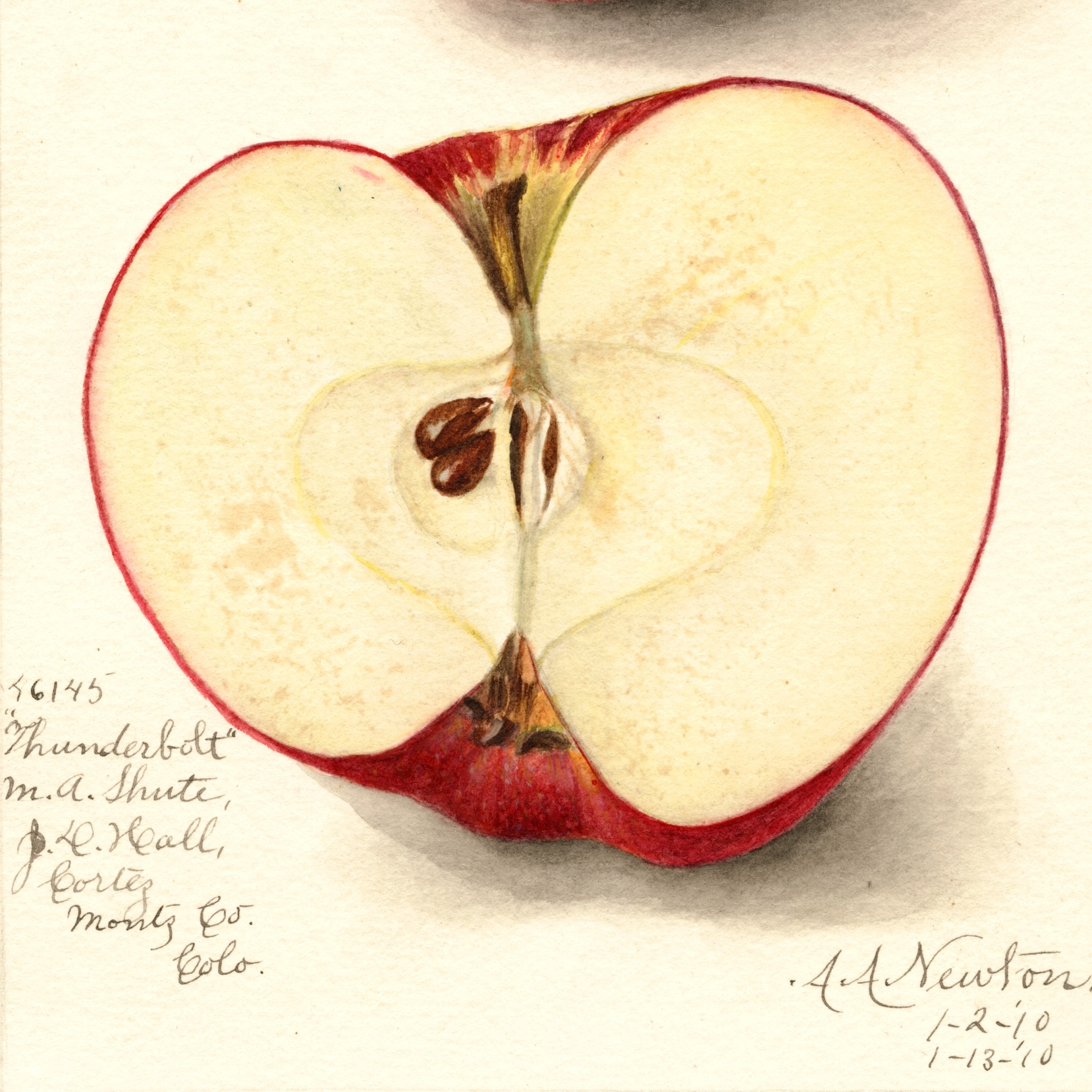
A dark red beauty, almost maroonish in color, splashed across the top with flecks of golden brown.
[00:02:03] Speaker B: They are such interesting looking apples, really different from anything you'd ever see in a grocery store. There's not a lot exactly like a thunderbolt.
[00:02:16] Speaker C: The Thunderbolt. Back then, they didn't realize that the hunt for this apple would change the course of their lives.
[00:02:24] Speaker B: So we read about the Thunderbolt first in this real estate magazine that was distributed in Denver back in the early 1900s, promoting the Montezuma Valley.
One of the apples they talked about in there was the Thunderbolt.
At the same time, we were becoming more and more aware of the extent of the old orchards that were still in Montezuma County. So when we read the article, we're like, well, maybe there's a thunderbolt in one of those old orchards.
[00:02:56] Speaker C: By the time the Schuenemeyers went looking for the Thunderbolt. There were just a few hundred acres of remnant orchards in the area, and the apple common in the early 1900s had all but vanished.
The Schuenemeyers scouted old orchards. They talked to longtime locals who remembered the Thunderbolt. Two years went by, and eventually someone introduced Jude to a guy named Conrad Hover.
[00:03:27] Speaker E: He came out, and he was kind of interested in the apples and what I had. And then I told him about this thunderbolt.
[00:03:33] Speaker C: Conrad Hover is 67 years old. He's got a few acres of apples on his property, and out at the edge of his orchard, there is one very old Thunderbolt tree.
[00:03:44] Speaker E: Yeah, he was pretty excited because he said as far as he knew, that there wasn't any left in Montezuma county, that this was probably the only Thunderbolt there was. So he was kind of excited about it. Up until then, it was just another tree. But.
[00:04:05] Speaker C: The Schuenemeyers were able to take cuttings from the tree to graft new baby Thunderbolts. And after two years of searching, they finally got to taste a ripe Thunderbolt apple for the first time.
[00:04:18] Speaker B: The Thunderbolts were just utterly amazing. The most explosive flavor you have ever had. When you bit into them, I mean, you take a cutting off and you bite it, you're just like, holy cow. We were blown away.
[00:04:35] Speaker C: The search for the lost Thunderbolt was a relatively easy case. In the realm of apple detective work, sometimes finding a lost variety is impossible. Sometimes an old tree of interest has entirely unknown origins.
[00:04:50] Speaker F: Some of them take years. And those. Those are the mysteries.
[00:04:55] Speaker C: John Bunker is an apple historian in Maine, and he's the author of Apples and the Art of Detection, which chronicles just how tricky finding and identifying rare apples can be.
[00:05:07] Speaker F: You know, there's apples that I have growing because I love them so much, and I grafted them and planted them in our orchard 10, 15, 20, 30 years ago. I still don't know what they are, but I'm working on it.
[00:05:21] Speaker C: Bunker says one reason apple trees offer a connection to the past is simple. They can live a long time, even when they're untended, for decades.
[00:05:30] Speaker F: I know at least a couple apple trees in Maine that are documented to be over 220 years old. That's twice as old as any person on earth.
[00:05:43] Speaker C: These old trees, he says, are living historic artifacts, often invisible to the people who see them on a daily basis.
[00:05:53] Speaker F: This is not like looking at a painting or sitting in a chair that you're not supposed to sit in. This is like eating the exact fruit that Benjamin Franklin or Thomas Jefferson ate. And in some cases, the same fruit from the same bloody tree.
[00:06:15] Speaker C: It's been 20 years since the Schnemeyers went looking for the lost thunderbolt. And these days, their apple detective work is more involved.
[00:06:25] Speaker B: It is still so thrilling. But you gotta understand, most of what we find, we may never be able to put name to it. Doesn't mean they weren't valuable cultivars. The names just may be too far lost.
[00:06:38] Speaker C: These days, they use genetic data sets and map the geography of every old tree. And they care for nurseries and orchards full of rare varieties of nameless apples.
[00:06:49] Speaker B: When we started doing this, we didn't know how hard or how complex or how long this project was going to be, right? It's like, well, let's go see if we can find a few trees.
[00:06:59] Speaker C: They did find a few trees. Then many, many more. And along the way, they've learned that a heritage apple isn't just a piece of fruit. It's an historic artifact, a time machine, a portal into a lost world of taste and desire.
[00:07:18] Speaker B: When you take a bite out of an apple cultivar that's been around for hundreds of years, that is a taste you would not find in a grocery store.
That is a flavor profile from a long time ago.
[00:07:36] Speaker C: From Montezuma County, Colorado, I'm Adam Burke.
[00:07:44] Speaker A: This story was produced by Adam Burke in partnership with Southwest Colorado's 250-150-local organizing committee, working to commemorate Colorado's 150th anniversary of state statehood. More information is at colorado150southwest.org.